Monday, April 8, 2013

Manga!

Oh man!  I haven't updated this thing for two months.  I completely understand if by this point you've all found new blogs to follow; I understand that you have needs and that I've not been attending them.  But that stops now, and I intend to win back your heart.

With manga!  I used to have a very low opinion of manga. I picked up one or two series over the years and found both the plot and the artwork goofy as hell.  I know I'm not the target demographic, but that doesn't stop other young adult books or even children's books from being appealing.  I just thought manga was something for which I had a special distaste, but now I've read enough manga that I found enjoyable that I feel the need to make a special post to apologize.

It all started when I was given the first of Osamu Tezuka's eight-volume epic series about the life of Buddha. The art still had a little of that goofy cartoonish feel that had turned me off in the past, but occasionally you would come across scenes like this one:


In other words, the simple manga characters would all of the sudden be walking around a beautifully detailed landscape.  Call me shallow, but encountering these scenes every few pages helped remind me that Tezuka wasn't doing simple drawings because he couldn't do better.  Here are three scenes from another great Tezuka work, Ode to Kirihito, which is one of the most original, strangest, and most compelling pieces of fiction (not just graphic fiction) that I've read in several years:

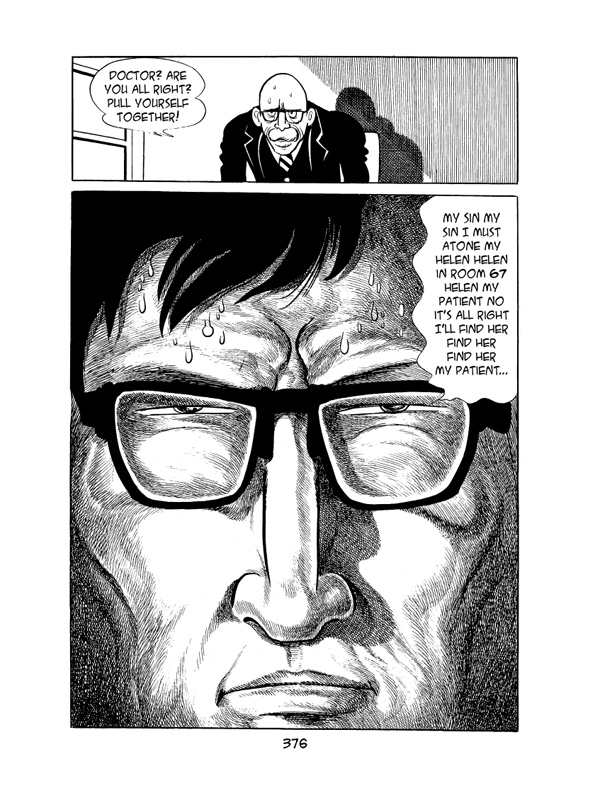

Ode to Kirihito really blew my mind and made me completely rethink my attitude toward manga.  Since then, I've been finding more and more manga that rises above the goofy.  I even found some non-fiction!  What follows are some brief discussions of some of the really amazing stuff.

First, the Manga Guide series, about which I really can't say enough good things.  Essentially, they are subject guides to some pretty tough topics, like statistics, cosmology, molecular biology, etc.  There is a very skeletal plot (a student needs a crash course in a certain subject over the summer or something) but it's nothing more than a framework on which to build a lesson.  Not only are they chock full of handy visual illustrations (duh), but they are extremely well-written (and well-translated) so that you never feel like you're reading a textbook.  They break down complex topics in a fun, accessible way:

From The Manga Guide to Relativity
If only I had known about them in high school, I might not have dropped calculus to take music theory in my senior year (the results of which were that I had to retake it in college and my high school grades actually got worse, probably because I am a musical philistine).

Another super awesome manga series is Oishinbo.  It can't truly be called non-fiction, because there are fictional characters and a simple plot, but in the same way as the Manga Guides both are basically devices used as excuses to discuss Japanese cuisine and food culture.  For example, as part of his work as a newspaper reporter, the main character is tasked with creating an Ultimate Menu of Japanese food (it's a tough job, but someone has to do it) so he goes hither and thither learning about different cooking techniques.  In reality though, the reader is getting simple lessons in things like how to cut fish properly, how chopsticks are made, dining etiquette, and other things to help you look smart at parties.  There are specific volumes on vegetables, sushi, ramen, rice, and other topics, including sake:

This one reads right to left!
And finally, I've saved one of the best for last.  Yoshihiro Tatsumi was a highly influential artist that experimented with alternative forms of manga, and helped develop what came to be known as the "gekiga" style, which is different from previous manga in that it's intended for an older audience and has a more realistic, dramatic style of illustration.  It's interesting not only from an art history standpoint, but it's an exceptionally open and honest book.  Tatsumi discusses his feelings of inadequacy as an artist, his family issues, and other really personal topics.  The result is a glimpse inside the mind of a truly original artist:

So don't make the same mistake I did and write off manga as just for children, or too goofy to be seen reading on the train.  Just like with most other things in life, there is way more going on here than you see at first glance.  If nothing else, you're going to stumble across some truly amazing pen and ink work that evoke a completely different culture and way of thinking about the world.  You could do worse. 

Tuesday, February 19, 2013

"Where Things Come Back" by John Corey Whaley

A while back a few friends of mine decided they wanted to raise chickens, so they ordered some from the internet (as one does).  Two of the chickens turned out to be roosters, which they took it upon themselves to announce to the world every day, multiple times per day, usually in the morning when human beings prefer to be asleep.  They also took to harassing the hens, as roosters apparently will do if they don't have a ton of room to roam around (these particular birds are being raised in a vacant lot on 24th St. in the Westside neighborhood).  They would jump all over the hens, prevent them from eating, and otherwise act like jerks.  In other words, these roosters had to go.

Now as you may or may not recall, a few months ago we butchered a pig in the library.  My friend Adam is one of the butchers who put on the event for us.  When he got wind of this rooster situation, Adam invited us over for a home-cooked chicken dinner at which he would solve this rooster problem once and for all, farm-to-table style.  Or, in this case, urban-KCMO-to-table style.

I will spare you (most of) the gory details.  Suffice it to say that the knife pressure required to slit a rooster's throat and the pressure required to cut its head completely off are very similar.  The first rooster's final minutes were about as peaceful as you could hope for them to be.  Adam is a firm but gentle hand, and he even spoke to the rooster before dispatching it, thanking it for what it was about to provide and wishing him luck wherever he was going.  A few seconds of kicking and the rooster was gone.

The second rooster was not quite so fortunate.  After some similar thoughtful words, Adam took the knife to him and his head popped right off.  The thing immediately started flapping and running in place (it was being held down by another friend, who had raised the roosters from eggs, and whose horror I cannot imagine).  It was thrashing around with such force that when the wings hit the plastic table it sounded not unlike the SWAT team demanding entrance into a house.  BOOM BOOM BOOM.

Here is something you may not have known:  being headless does not stop a rooster from vocalizing.  So not only was this dead rooster attempting to get up and run away from us, it was also trying to crow.  For the next few minutes I was the world's strictest vegetarian.  I have rarely made as firm of a resolution as I did there, in that alley, to never eat chicken again (note: I ate this exact chicken not 30 minutes later).

Oh, and chickens can also still poop when they're dead.  Heads up for that.

Anyway, the plot of Where Things Come Back revolves around a disappearance and a reappearance.  Gabriel Witter, the fifteen-year-old brother of the story's narrator, Cullen Witter, has vanished without a trace from his hometown of Lily, Arkansas.  Almost simultaneously, a giant woodpecker thought to have been extinct for decades is sighted in the woods outside of Lily by an outsider named John Barling.   In a parallel plot, a young missionary named  Benton Sage struggles with his faith and searches for a purpose in life.  (All the characters' names in this book are ridiculous.  Benton Sage's roommate is named Cabot Searcy.)

Mostly, the book is about trying to make sense out of death, and of life.  The book opens with the death of Cullen and Gabriel's cousin Oslo (seriously?  Oslo?) from a drug overdose.  One of the main female characters, Ada Taylor, tends to have boyfriends that either die or manage to seriously injure themselves.  The parallel plot features a suicide that throws the life of his friend into a tailspin and a desperate search for meaning in existence.

I have to confess, I didn't like this book at first.  I was convinced that I was in for yet another retreading of the angst-filled first-person teenage novel.  Where Things Come Back is much better than that.  It deals with life, death, and the middle space in between (for most of the book, we don't know if Gabriel is alive or dead) in a way that is honest and sober.  It avoids magnifying the emotions of the characters into melodrama, which I always appreciate and honestly think is usually unnecessary, since death is profound enough when you really stop and think about it.

Where Things Come Back is also a very well-constructed book.  The "will they find Gabriel" storyline and the "will they find the woodpecker" storyline play off each other nicely.  There is some symbolism in the book that I thought was a little ham-handed (the woodpecker is called the Lazarus Woodpecker) I'm sure it sounds better if you're not such a cranky reader.

At the end of the day, I thought Where Things Come Back did a really good job of addressing really complex topics and creating three-dimensional characters, and I recommend it, especially if you want to do a little deep thinking about death and loss after having witnessed a bird die, seemingly come back to life, die again, be stripped of half its feathers, and then poop all over the table.

Wednesday, January 23, 2013

"Hole in my Life" by Jack Gantos

I typically dislike memoirs.  The travel writer Paul Thereaux identifies a type of complaining while bragging that afflicts travel writing ("I hadn't showered in nearly TWO DAYS when I arrived at my hotel in Bali and handed my bags to the valet") and to an extent I think that this infects memoir as well.  Most memoirs just make me want to say to the author, "hey man, we all have problems."  The worst examples of the genre are either self-congratulatory, self-aggrandizing, or just plain made up.  It's like being cornered at a party by the most boring person in the room, and being unable to break away to talk to any of the cool people you see across the way (the cool people in this metaphor being other non-fiction books).  Not once but twice for Library Journal did I have to review the memoir of some Hollywood producer who went on for PAGES about how much money he was paid to produce certain television shows.  Specific dollar amounts.  For pages.  This is usually what I think of when I think of memoir.

Hole in my Life is none of those things.  It's witty, insightful, self-deprecating, and Jack Gantos has led the kind of life that has given him a unique set of experiences to write about, and a unique voice with which to do so.  In fact, one of the main themes of the earlier parts of the book is how the young Gantos, an aspiring writer, realized he had nothing to write about and set out to liven up his life.  He bounces up and down the East Coast working various jobs and meeting various seedy characters.  Eventually, he finds himself agreeing to help sail a boat loaded with hash up the eastern seaboard to New York in exchange for $10,000 which he hopes to use to get into college and study writing.

Needless to say, the whole thing goes metaphorically south (the whole thing goes literally north) and Gantos finds himself in prison.  The remainder of the book is a hard, honest look at the decisions that led Gantos to his incarceration, and the consequences.  A particularly moving scene sees Gantos's father and uncle arrive at the prison stinking drunk, which is the only way his father could muster the courage to see his son living inside a prison.

The only quibble I had with the book is that there is a reference some piece of classic literature on practically every single page.  This is the same problem I have with Tim O'Brien.  You only need to drop so many of those before you fail in the attempt to convince the reader you are well-read and instead come off sounding desperate to place yourself among Other Serious Writers.  I randomly picked a 20 page span, pages 30-50, and found references to Flannery O'Connor, Go Ask Alice, Jack Keroac and On the Road, Hallucinogens and Shamanism, Edmund O. Wilson, Stephen Crane and Red Badge of Courage, Ernest Hemingway, and John Hersey.  Holy cow!  At a certain point it gets to be distracting.

There are many directions to take readalongs for this book.  For other examples of true crime in the 60s and 70s, you can pick up either of Nicholas Pileggi's books, Wiseguy or Casino, which were turned into the films Goodfellas and Casino respectively and feature much more competent criminals.  If you got interested in the nautical portions of Gantos's tale and are interested in reading about how non-smugglers sail the high sees, check out Joshua Slocum's awesome, epic, hilarious recounting of that time he was the first person to sail alone around the world, aptly entitled Sailing Alone Around the World.  Or, you could pick up any of the innumerable books that Gantos mentions in Hole in my Life.

Tuesday, January 8, 2013

"Swim the Fly" by Don Calame

Swim the Fly is the story of three friends who make a pact to see a "real live" naked girl by the end of the summer, then spend the entire book going to greater and greater lengths to achieve their goal.  They sneak into a girls' locker room (which is unsuccessful because one of them suddenly has an attack of diarrhea), hide in a closet to try to catch their classmates having sex, peep on people in a changing room the mall, and finally bring a pair of binoculars to a nude beach.

Ok, am I wrong to be super creeped out by this book?  All that shit listed above is super creepy, right?  And if one of the characters were to, say, take a cell phone picture of his classmates in flagrante and post it to Facebook, that is basically cyber bullying of the worst order, right?  What am I missing here?  Why am I rooting for these characters to succeed?  I DO NOT WANT PEOPLE LIKE THIS TO SUCCEED.  The only point at which any of the characters thinks that maybe, just maybe, there is something wrong with this behavior is when the narrator and his two friends hatch a plan to look over the top of the dressing room walls at a bathing suit store to try to see their two female friends changing.  The narrator's tiny pubescent conscience finally starts to bother him, so he deliberately thwarts his friends' best attempts to commit sexual harassment (assault?).

Maybe I am misremembering adolescence   I remember it being a feral struggle to survive; a constant, desperate battle to climb on top of others before they climbed on top of you.  I remember being mercilessly mocked by my teammates on the wrestling team when they found out I took dance lessons, and I remember being part of the mob that doled out pink bellies to people who violated the proto-bro code that ruled wrestling practice.  I remember being pantsed at soccer practice by a senior when I was a freshman.  I remember hating every second of it.  I remember being mystified by girls and wanting to figure them out.  I do not, however, remember conniving to see people naked without their consent, nor do I remember any of my friends seriously suggesting it.

Am I taking this work of fiction too seriously?  I know this kind of stuff, and worse, happens every day in every school.  But in Swim the Fly it's presented as a natural outgrowth of teenage thought, and it happens with essentially no consequences.  We don't witness the reaction of the student whose underwear picture was posted to Facebook.  That happens off camera.  Also it happens to a girl, so who cares.  Gs up hoes down, amirite?

I dunno.  I'm feeling like maybe I'm missing something about this book, but the more I write about it, the angrier it makes me.  To do, or attempt to do, the things that the main characters do in this book is simply not cool, to put it mildly.  They are these guys.  I know that's how teenagers naturally behave, but can we all agree that the entire point of education is to eventually STOP them from behaving like that?  Books like this are not helpful to this end.

I honestly don't know what to suggest as readalongs for this book.  Maybe some stuff that I read when I was this age?  I remember being way into Tom Clancy and Michael Crichton in middle school, Kurt Vonnegut in high school.  Cassie also suggested I do listenalongs.  Bands I was into in high school (on the less embarrassing end of the spectrum) include Rage Against the Machine, Tool, Reel Big Fish, and, of course, The Doors.

Now I'm all depressed.  Thank God in heaven that I never have to go back to high school.

Monday, January 7, 2013

"This Is Not My Hat" by Jon Klassen

Ok, so the goal of this blog was mostly to build my familiarity with teen literature.  This Is Not My Hat is a children's picture book that I was handed this morning.  I had to blog about it because it's so awesome.

Here is the plot:  a tiny fish steals a hat from a sleeping gigantic fish.  The tiny fish brags to the reader about his derring-do and how he has gotten away with the theft.  The tiny fish attempts to escape the notice of the gigantic fish by fleeing into the cover of some seaweed.  Slowly, the gigantic fish rouses himself and goes about tracking down the tiny fish.  In the final pages of the book (SPOILER ALERT) we see the gigantic fish enter the seaweed in which the tiny fish has concealed himself.  We don't see what happens in there, but the gigantic fish reemerges with his hat, looking quite smug.  What has happened to the tiny fish?  We are never told.  The last page of the book is a still shot of the seaweed, with no tiny fish to be seen.

This is not your typical children's book where all the characters figure out their differences and the final illustration depicts them all chummily sharing a birthday cake, or whatever.  Clearly, the tiny fish has received his comeuppance.  What kind of revenge has the gigantic fish exacted?  Is the tiny fish dead in the seaweed?  Did the gigantic fish eat him?  The reader is free to speculate.

The color palette of the illustrations makes the tone of the book even more ominous.  The predominant color is black, which I suppose is accurate since the book takes place at the bottom of the ocean.  The last image of the book, seaweed in the inky depths that may or may not contain the lifeless body of the book's narrator, was pretty jarring I thought.  Here is a picture of the tiny fish getting snitched on by a crab, while he glibly claims that this is something that will never happen:


Look at the seething menace on the face of that gigantic fish!  He is not playing!  He's going to get his damn hat back.

And what's the message here?  Typically we tell kids, "you shouldn't steal because it is the wrong thing to do."  Or, "stealing hurts people."  Instead, here the message is "children, you will NOT get away with stealing and you will probably catch a beating for it."  Also, "please do not think you have the world figured out, children."  This is most likely true, and I find the honesty pretty refreshing.

If you haven't read any picture books in awhile, do yourself a favor and pick one up.  Last week our Youth Services staff had a mock Caldecott Award committee exercise and I got to spend some time reading the nominees.  I had forgotten how amazing picture book art can be, especially when it's used in the service of a good story.

I'm not going to bother with adult readalongs here.  Just go read some children's books.  Our Youth Services staff picked More by Brian Lies as their favorite, but I was rooting for Chloe by Peter McCarty.  Also check out Extra Yarn by Jon Klassen (same author as above) and Chloe and the Lion by Mac Barnett (illustrated by Adam Rex).  Maybe listen to some Lullatone or Shugo Tokumaro to get in the proper mood.

Thursday, December 13, 2012

As Easy as Falling Off the Face of the Earth by Lynne Rae Perkins

When I was in approximately third grade my parents had a miscommunication of some sort with the other family that we carpooled to school with.  The other kid, Jessica, had volleyball practice or something, my folks thought hers were picking us up and hers thought mine were, the end result of which was me standing outside of my elementary school watching the parking lot slowly empty and having the gradual realization that something had gone wrong.  Eventually it became quite clear that no one was coming.  Also, as if God knew I would blog about it at some point, it began to rain.

At this point my options were several.  I could have gone back to my classroom and asked my teacher for help.  I could have gone to the office and asked to use the phone to call my parents.  I could have gone to the gymnasium to find Jessica.  All of these would have been reasonable solutions.  Literally none of them occurred to me.  You can chalk it up to stubbornness, panic, or (I prefer) inborn fortitude, but the only thought that entered my nine-year-old brain was "Well, guess I'd better get walking."  A quick Googling reveals the distance between my school and my home at the time to be a little than one and a half miles.

I remember knowing it was a stupid idea but doing it anyway.  This probably reveals something about the adult I would eventually become.  I alternately walked and ran, to save time I guess.  At one point I was running along and a car pulled out of an alley in front of me, blocking the sidewalk.  By this time it was raining heavily and I was soaked.  The driver was waiting for a chance to pull onto the street, but it wasn't coming.  I waited, patiently, standing in the rain.  It did not occur to me to walk behind the car.  Eventually the driver noticed me standing there, looking pretty pathetic I'm sure, and backed up to unblock the sidewalk.  I went on my merry way.

I didn't make it all the way home.  At some point a family friend happened to pull up alongside me at a stoplight and very reasonably asked me what I was doing on the street, in the rain, by myself.  She took me home and called my parents, of whose reaction I have no recollection but I'm sure was a mixture of  astonishment, confusion, and bafflement at my lack of good sense (it would not be the last time).

All of which is essentially the plot of As Easy as Falling Off the Face of the Earth.  A teen named Ry is shipped off to a summer camp but becomes lost when he steps off of his train to make a phone call and it leaves without him (the summer camp had ceased to exist while he was en route anyway, for reasons I can't quite remember).  He tries to contact his parents, but his parents are on a sailing tour of the Caribbean.  He tries to contact his grandfather, but his grandfather has fallen in a sinkhole and hit his head.  In other words, circumstances have conspired against him.  Luckily, the first person he happens upon is a man named Del who is not only willing to drive him from Montana to his house in Wisconsin, but from Wisconsin to Florida, where they fly to the Caribbean, where they sail around looking for Ry's parents.  (If only that dude blocking the sidewalk in Crawfordsville, Indiana had been so adventurous.)

Along the way, the pair of course have numerous adventures and become good friends.  Ry gains confidence and gives Del advice from his innocent and therefore unsullied perspective, which helps Del reconcile with his ex-wife.  The police find Ry's grandpa.  Ry happens upon his parents in the vast Caribbean island chain just as they are casting off for the open sea.  Oh, and the dogs, which I forgot to mention, make their way home via airplane somehow (this part of the book is illustrated, not written out, and seems pretty extraneous to me).

As Easy as Falling Off the Face of the Earth is essentially On the Road without the amphetamines.  The plot is straight as an arrow, which I'm sure is satisfying if you like that sort of thing.  I had some of the same problems with this book that I did with Skin Hunger, which is to say that everything is the same at the end of the book as at the beginning.  The resolution takes place in about 20 pages at the end, and up until that point all we do is follow Del and Ry on their road trip.  As anyone who has even been in a car knows, road trips are fun for about the first two hours.  After that you're sick of highway food, your back hurts, and whatever poor sap is in the car with you has become the focus of all your annoyance.

And while the author does her best to plug up the plot holes, it remains to me strikingly unclear why a 15-year-old boy is willing to drive cross-country with a complete stranger instead of, I don't know, calling the police.  Calling his friends.  Emailing someone.  But hey, I guess I am walking proof that sometimes all you can think of is to get your self moving, so fair enough.

Readalongs are going to be tough for this one.  The book doesn't stay in one place for very long at all.  I honestly think On the Road is a pretty similar (and equally frustrating) title.  In that vein, The Odyssey is the prototypical journey book.  Bill Bryson's I'm a Stranger Here Myself is a book with a similar amount of wanderlust, and is written in a similarly jaunty, witty style (I always feel bad recommending Bill Bryson, which to me is like recommending The Beatles, but come on, The Beatles really are awesome).

I would recommend As Easy as Falling Off the Face of the Earth, even though I didn't really love it.  The writing is extremely accessible and personable.  The characters are pretty well-developed and three-dimensional, if not excessively realistic.  And while I had issues with the meandering plot, overall the book was a very good read.  But who needs realism?  We all get plenty of that every day.

Tuesday, December 4, 2012

Seedfolks by Paul Fleischman

Oh man, did I fall off the wagon.  It was only partially my fault!  First, I had several Moebius graphic novels come in via ILL that I had been waiting weeks for.  Then, I admit to getting very sidetracked by Bruce Chatwin's incredibly beautiful and strange In Patagonia, which is part world history, part hitchhiker's memoir, part outlaw storytelling, part ships-at-sea tale.  It is right now one of my current top ten favorite non-fiction books, but let's see how it looks when memory fades.  Also, Cassie Coles very kindly noticed my rekindling affection for poetry in my posting about Out of the Dust, so she gave me an awesome poetry anthology to pick through and it distracted for a couple of weeks.  It's called Poetry 180 and its designed to offer high schoolers one poem to read per day that they will find not only meaningful but also accessible.  None of that obscure garbled nonsense that you can only get into if you live in a dormitory and/or you've decided to become "well read" to impress your friends.  I also had a personal connection to two poets whose work was in the book.

I took a poetry class from David Wojahn during my undergrad at IU, and I remember him being extremely kind and patient, which I guess you would have to be if you are going to listen to 18 year olds read poetry for the rest of your life.  One poem I wrote referenced the song "Rivers of Babylon" by The Melodians, which everyone else assumed was referencing the Bible but he got right away, which I thought was very hip (this possibly had something to do with my just having seen The Harder They Come for the first time). The other poet was Galway Kinnell, who passed through Crawfordsville, Indiana while I was in tenth grade or so to (I assume) give a talk at Wabash College, and he was awesome enough to come to my high school afterwards and talk to all the kids who were interested in staying after school to meet a poet that our English teacher promised us was worth meeting (there were four of us).

At neither time did I really realize who these people were and what they were really doing.  Here were two major poets that I had the opportunity to learn from and ask questions of, and if I knew then what I know now I would have spent less time worrying about how cool (or not) I looked in front of my friends and more time just hanging around those dudes.  But hey, such is life.

Which brings me, in a roundabout way, to Seedfolks.  Essentially, Seedfolks is a story about individual people coalescing into a community around a shared garden space.  A young girl plants a seed in a vacant lot, someone notices it and starts to tend it, someone notices him and brings their own plants, someone notices the group and soon people are setting up plots, bringing in irrigation, and just generally helping each other.  The characters are broadly diverse, and the garden helps them bridge gaps of race, gender, and especially generation.  Each chapter focuses on a different character, so the book takes the form of vignettes that come together to make a larger whole.  The chapters are short and digestible, perfect for minds that are used to rapidly changing channels.  It sort of sneakily paints a macro level picture while making you think you are reading about micro level stuff.  In other words, it is an extremely successful piece of writing.  This book is a hollow point, if you'll forgive the metaphor.  When it gets inside you, it rapidly expands and has a lot more effect than you thought it would.  If you can forgive the goofy, early-90s, after-school special way that the book deploys the concept of diversity (which I think is a very easy thing to do), I think you will highly enjoy this little book.

For readalongs, I would probably send patrons home with urban farming materials.  Storey's Basic Country Skills is a good one, full of farming instructions but also cool stuff like recipes and random things like building a barn.  There is also the classic Foxfire series of magazines and books about getting "back to the land."  Both of these works contain cool things that you can do yourself even with little access to open, rural space. If I were feeling bold, I might suggest some short stories by Maupassant or Maugham based on the structure of Seedfolks, whom I think are two of the better short-story writers to have taken up the pen.  If that one landed, I might put forward Fathers and Sons by Ivan Turgenev, which is about bridging the gap between generations but is also about the rise of nihilism in 19th Century Russia and I think it might be a bit of a stretch, but you can't win big unless you bet big.

As of now, I am 25% done with the book that Charlou picked out for me, which is As Easy as Falling Off the Face of the Earth.  I solemnly swear that I will read this book before any other, fiction or non, graphic or text-based.  Unless one of my ILLs comes in.